Google Ads vs SEO: Which One Is Better for Your Business?
- August 24, 2026
- Ayush
- 11:58 pm
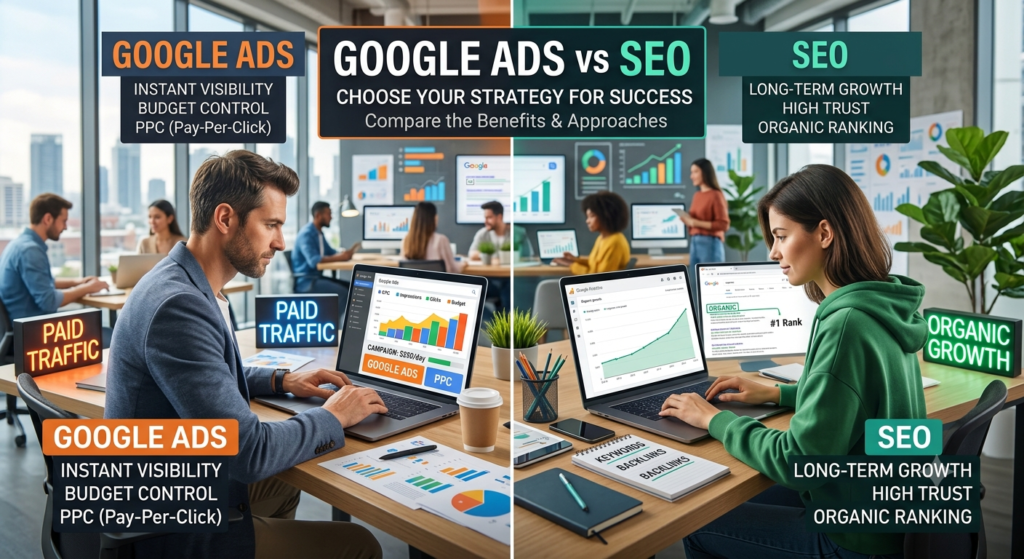
Google Ads vs SEO: Which One Is Better for Your Business?
If you want your business to appear on Google, two of the most common strategies are Google Ads and SEO. But which one should you choose?
Google Ads vs SEO is not simply a question of paid traffic versus free traffic. Both strategies work differently, require different investments, and are useful at different stages of business growth.
In this guide, we will compare Google Ads and SEO, explain their advantages and disadvantages, and help you understand which strategy can be better for your business.
What Is Google Ads?
Google Ads is Google’s paid advertising platform that allows businesses to show advertisements when people search for specific keywords.
For example, if someone searches for “Google Ads agency”, businesses can bid on that keyword and potentially appear at the top of Google’s search results as a sponsored advertisement.
Google Ads is mainly useful when you want to generate immediate traffic, leads, sales, or conversions.
How Google Ads Works
Google Ads works through an advertising auction. Businesses choose relevant keywords, create advertisements, set budgets, and compete for ad placements.
Some important parts of Google Ads include:
-
Keyword research
-
Search intent
-
Ad copy
-
Bidding
-
Campaign settings
-
Conversion tracking
-
Landing pages
-
Budget management
Google Ads also provides different Google Ads settings that allow advertisers to control targeting, budgets, locations, audiences, bidding strategies, and other campaign options.
What Is SEO?
SEO, or Search Engine Optimization, is the process of improving a website so that it can appear higher in Google’s organic search results.
Unlike Google Ads, you do not directly pay Google every time someone clicks your organic result.
SEO focuses on improving different areas of a website, including:
-
Content
-
Keywords
-
Website structure
-
Page speed
-
Technical SEO
-
On-page SEO
-
Off-page SEO
-
Backlinks
-
User experience
For example, if someone searches for “What is SEO?”, a well-optimized website can rank organically for that search query.
Google Ads vs SEO: Main Difference
The biggest difference between Google Ads and SEO is how you acquire visibility and traffic.
Google Ads provides paid visibility, while SEO focuses on earning organic visibility through website optimization and valuable content.
| Google Ads | SEO |
|---|---|
| Paid advertising | Organic search optimization |
| Can generate traffic quickly | Usually takes longer |
| Requires an advertising budget | Requires SEO investment and resources |
| Traffic depends on active campaigns | Organic rankings can continue after optimization |
| Strong for immediate campaigns | Strong for long-term growth |
| Keyword bidding is important | Search intent and content quality are important |
| Results can stop when campaigns stop | Rankings can continue if maintained |
Google Ads vs SEO: Which Is Faster?
If your goal is quick traffic, Google Ads generally has an advantage.
Once a campaign is properly created, approved, and launched, your ads can start appearing for relevant searches.
SEO normally takes more time because search engines need to crawl, understand, evaluate, and rank your website.
This does not mean SEO is ineffective. It means the two strategies have different timelines.
Google Ads
Short-term visibility → Traffic → Leads/Sales
SEO
Content + Optimization → Rankings → Organic Traffic → Leads/Sales
Therefore, businesses that need immediate traffic may consider Google Ads, while businesses focused on long-term organic growth may invest heavily in SEO.
Google Ads vs SEO: Cost Comparison
Cost is another major difference.
With Google Ads, you generally pay when users interact with your advertisements, depending on the campaign and bidding model.
For example, competitive keywords can have high costs because multiple advertisers are competing for the same search terms.
SEO does not usually involve paying Google directly for organic clicks. However, SEO is not completely free.
You may need to invest in:
-
SEO professionals
-
Content writers
-
SEO tools
-
Website development
-
Technical improvements
-
Link building
-
Content production
So the better question is not “Is SEO free?”
The better question is:
“Which strategy gives my business the better return on investment?”
Google Ads vs SEO: Long-Term Results
SEO can have a strong long-term advantage.
Suppose you create a high-quality page targeting a valuable keyword and it eventually reaches the first page of Google. That page can potentially generate organic traffic for months or even years if the content remains useful and competitive.
Google Ads works differently.
When you stop spending on an advertising campaign, your paid search visibility generally stops as well.
This makes SEO particularly valuable for businesses that want to build a sustainable source of organic traffic.
However, SEO rankings are not permanent. Competitors can publish better content, search intent can change, and Google’s algorithms can change. SEO therefore requires continuous monitoring and improvement.
Google Ads vs SEO: Which One Gives Better Leads?
There is no universal winner.
The quality of leads depends on factors such as:
-
Keyword intent
-
Target audience
-
Industry
-
Landing page
-
Offer
-
Ad or organic listing
-
Conversion process
-
Website experience
For example, a user searching “buy Google Ads service” has a stronger commercial intent than someone searching “what is Google Ads?”
This is why understanding keyword intent is critical for both SEO and Google Ads.
Transactional Keywords
These users are closer to taking action.
Examples:
-
Google Ads agency
-
SEO services
-
Digital marketing agency
-
Buy SEO service
Informational Keywords
These users are primarily looking for information.
Examples:
-
What is SEO?
-
What is off-page SEO?
-
What is on-page SEO?
-
What is technical SEO?
A successful digital marketing strategy should match the right keyword with the right marketing objective.
Google Ads vs SEO: Advantages of Google Ads
Google Ads can be useful when a business needs fast visibility.
1. Faster Traffic
You can potentially start receiving search traffic shortly after launching a properly configured campaign.
2. Precise Targeting
Advertisers can target users based on factors such as:
-
Location
-
Keywords
-
Audiences
-
Devices
-
Language
-
Time
-
Search behavior
3. Easy Performance Tracking
Google Ads provides data that can help you analyze:
-
Clicks
-
Impressions
-
CTR
-
Cost
-
Conversions
-
Conversion value
-
Return on ad spend
4. Strong for Commercial Intent
Google Ads can be particularly effective when people are actively searching for products or services.
Disadvantages of Google Ads
Google Ads also has limitations.
1. Continuous Cost
You need an advertising budget to continue generating paid traffic.
2. Competitive Keywords Can Be Expensive
Highly competitive searches can have high CPCs.
3. Poor Campaign Management Can Waste Money
Incorrect targeting, weak keyword selection, poor ad copy, or ineffective landing pages can reduce campaign performance.
This is why understanding Google Ads Manager, campaign structure, bidding, targeting, and conversion tracking is important.
Advantages of SEO
SEO is a powerful strategy for businesses that want long-term visibility.
1. Long-Term Organic Traffic
Strong rankings can continue to generate traffic without paying for every organic click.
2. Builds Website Authority
Consistently publishing useful content and earning quality links can strengthen a website’s authority.
3. Supports Brand Visibility
Ranking for multiple relevant searches can increase your brand’s visibility throughout the customer journey.
4. Can Reduce Dependence on Paid Traffic
A strong SEO strategy can create another traffic source instead of relying completely on advertising.
Disadvantages of SEO
SEO also requires patience.
1. Results Take Time
New websites and new pages may need significant time to establish rankings.
2. Competition Is High
Some keywords have extremely strong competitors.
For example, the keyword “What is SEO?” has high search volume but also high competition. A new website may find it difficult to rank immediately.
3. Requires Continuous Optimization
SEO is not a one-time task.
You may need to update:
-
Content
-
Keywords
-
Internal links
-
Technical SEO
-
Page experience
-
Backlinks
-
Search intent
On-Page SEO, Off-Page SEO and Technical SEO
SEO is not just about adding keywords to a page.
What Is On-Page SEO?
On-page SEO focuses on optimizing elements that exist on your website.
Examples include:
-
Title tags
-
Meta descriptions
-
Headings
-
Content
-
Keywords
-
Internal links
-
Images
-
URLs
What Is Off-Page SEO?
Off-page SEO focuses on activities outside your website that can help improve authority and visibility.
Examples include:
-
Backlinks
-
Digital PR
-
Brand mentions
-
Online reputation
What Is Technical SEO?
Technical SEO focuses on the technical foundation of your website.
It can include:
-
Website speed
-
Mobile usability
-
Crawling
-
Indexing
-
Site architecture
-
Structured data
-
XML sitemaps
-
HTTPS
A strong SEO strategy normally combines all three areas.
Google Ads vs SEO: Should You Use Both?
For many businesses, the best strategy is not choosing between Google Ads and SEO.
It is using both strategically.
Google Ads can help generate immediate visibility while SEO builds long-term organic traffic.
For example:
Google Ads → Immediate Traffic → Leads → Sales
At the same time:
SEO → Organic Rankings → Organic Traffic → Leads → Long-Term Growth
This combination can create a more balanced search marketing strategy.
When Should You Choose Google Ads?
Google Ads may be a better option when:
-
You need traffic quickly
-
You are launching a new product
-
You have a limited-time offer
-
You want immediate lead generation
-
You have a measurable conversion goal
-
You have enough budget to test and optimize campaigns
However, having a budget alone does not guarantee results. Campaign strategy, keyword selection, targeting, landing pages, and conversion tracking are equally important.
When Should You Choose SEO?
SEO may be a better option when:
-
You want long-term organic traffic
-
You want to build website authority
-
You regularly create valuable content
-
You want to reduce dependence on paid traffic
-
Your business has valuable informational search opportunities
-
You can invest time in long-term growth
SEO is especially useful for businesses that can create content around different stages of the customer journey.
Google Ads vs SEO: Which Is Better?
There is no single answer to Google Ads vs SEO.
If you need immediate traffic and leads, Google Ads can be the stronger short-term option.
If you want long-term organic visibility and sustainable traffic, SEO can be the stronger long-term strategy.
For many businesses, the most effective approach is to combine both.
Use Google Ads for immediate opportunities and use SEO to build long-term search visibility.
The right choice depends on your:
-
Business goals
-
Budget
-
Competition
-
Industry
-
Search demand
-
Customer journey
-
Conversion value
-
Marketing timeline
Conclusion
The Google Ads vs SEO debate is not really about which strategy is universally better.
It is about choosing the right strategy for the right objective.
Google Ads can provide faster visibility, targeted traffic, and measurable advertising performance.
SEO can help build organic rankings, website authority, and long-term search traffic.
If your business has the resources, combining Google Ads + SEO can create a stronger digital marketing strategy than relying on only one channel.
The most important step is to understand your audience, research the right keywords, identify search intent, and measure conversions rather than focusing only on traffic.
Want to improve your website traffic and generate more qualified leads?
Start by analyzing your current SEO and Google Ads performance, identify the biggest opportunities, and build a search strategy based on your business goals.
Need help with SEO, Google Ads, or performance marketing? Contact us today and let’s build a strategy that focuses on real business results.